

Data Engineering · Architecture · 19 min
Modern Data Stack Guide: Snowflake, dbt, Fivetran and Databricks — What Each Layer Does and When You Need It
A vendor-neutral guide to the layers of a modern data platform, what each tool does, and when you need it—or don't.

Direct answer
What do Snowflake, dbt, Fivetran and Databricks do?
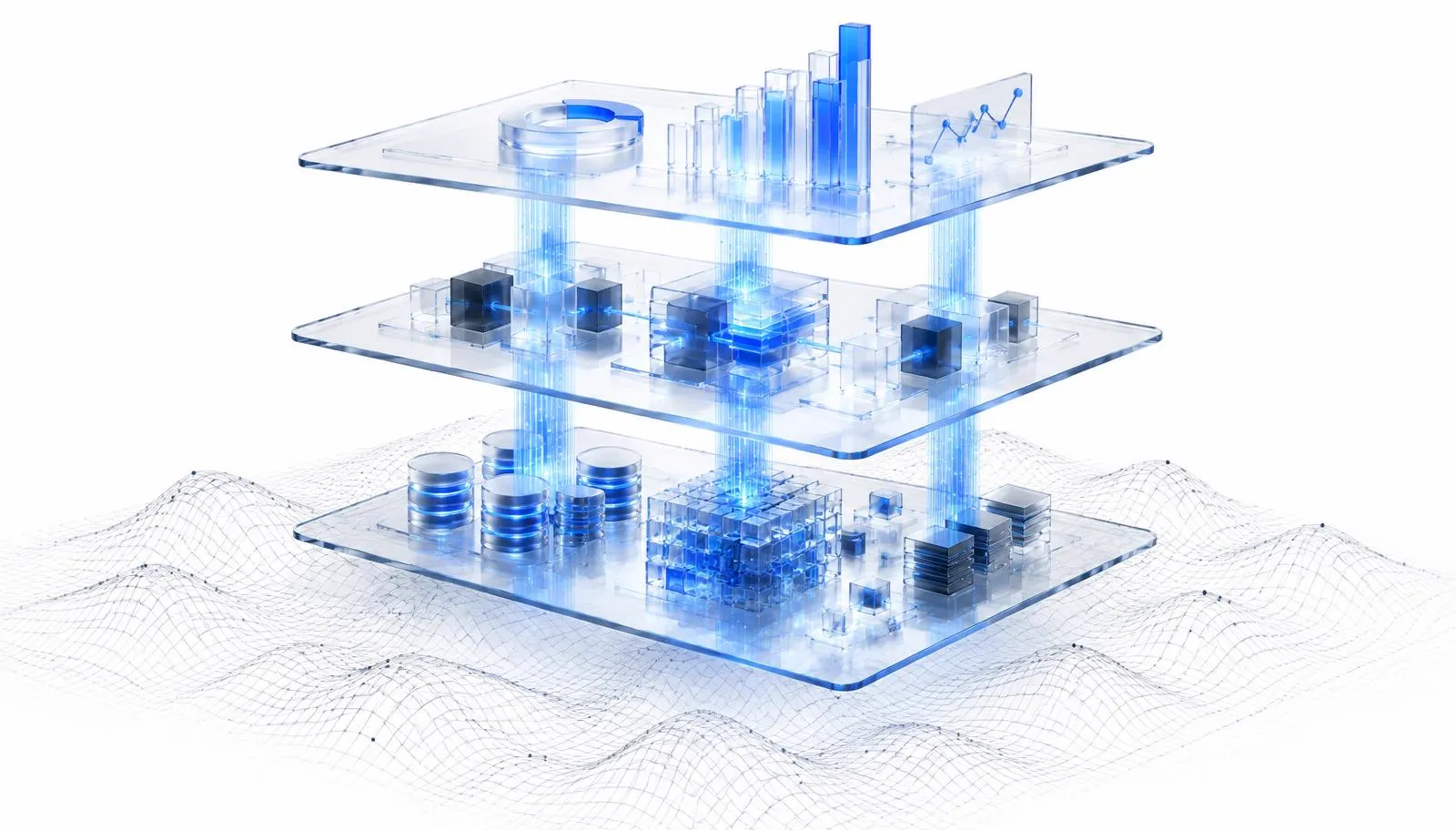
Snowflake, dbt, Fivetran and Databricks solve different parts of the data lifecycle. Fivetran primarily moves data from supported sources into a destination. Snowflake provides cloud data storage and analytical processing. dbt manages SQL-based transformation and modelling as version-controlled code. Databricks provides a broader environment for large-scale data processing, engineering and advanced analytics built around Apache Spark. Their capabilities increasingly overlap, and a company does not automatically need all four. Architecture should follow the workload.
Key takeaways
- A modern data stack is a set of layers, not a vendor bundle.
- Ingestion, storage, transformation and consumption are different responsibilities.
- dbt transforms data already in the platform; it does not move data from sources.
- Snowflake and Databricks overlap, but typically start from different strengths.
- Many mid-sized businesses need fewer layers than vendors suggest.
- Operations—testing, CI/CD, monitoring and cost control—are part of the stack.
What is a modern data stack?
A composable, cloud-oriented data architecture in which separate tools handle ingestion, storage and processing, transformation, consumption and operations. It describes a pattern, not a product.
Older data platforms were often one large system that extracted, stored, transformed and reported. The modern pattern splits those responsibilities across specialized, usually cloud-hosted services connected through standard interfaces—most often SQL. The benefit is flexibility: each layer can be chosen, scaled and replaced independently. The cost is that someone has to design the whole, own the joins between layers and control spend across several subscriptions.
That trade-off is why the most useful question is not 'which modern data stack should we buy?' but 'which responsibilities does our workload actually require, and what is the simplest reliable way to cover each?'
- 01SourcesCRM · ERP · Applications · Databases · Files · APIs
- 02IngestFivetran · connectors · custom ingestion
- 03Store & processSnowflake / Databricks, depending on workload
- 04Transformdbt · SQL · Spark · PySpark
- 05Model & validateBusiness models · quality rules · testing
- 06ConsumeBI · analytics · applications · AI / MLOperations run beneath every layer
- 07OperateCI/CD · monitoring · security · governance
Tools belong to layers. Architecture belongs to the business requirement.
The Modern Data Stack Layers
Xyncwave's layer model separates responsibilities from tools. Tools belong to layers. Architecture belongs to the business requirement.
Sources
CRM, ERP, operational applications, databases, files and APIs—where data is created. Nothing downstream can be more reliable than the source ownership agreed here.
Ingest
Moves data from sources into the platform. Examples: managed connectors such as Fivetran, cloud orchestration such as Azure Data Factory, or custom ingestion code.
Store & process
Holds data and provides compute to query and transform it. Examples: Snowflake or Databricks, depending on the workload—and sometimes both.
Transform
Cleans, combines and reshapes data. Examples: dbt, SQL, Spark or PySpark.
Model & validate
Business models, quality rules and tests that make data dependable and understandable.
Consume
BI and reporting, analytics, applications, and AI or machine-learning workloads.
Operate
CI/CD, monitoring, security, access control, governance and cost management. This layer is often forgotten in tool comparisons and is usually where platforms succeed or fail.
What role does Snowflake play?
Snowflake is a cloud data platform most commonly used as an analytical warehouse: it stores structured and semi-structured data and runs SQL workloads for analytics and transformation.
Snowflake's documented architecture separates storage from compute. Data is held in a central storage layer, while independent compute clusters—called virtual warehouses—run queries. Conceptually, this means different teams or workloads can use separate compute without competing for the same resources, and compute can be sized or suspended independently of how much data is stored.
In practice Snowflake is often the place where raw data lands, where transformation runs (frequently orchestrated by dbt), and where BI tools query modelled data. It also supports non-SQL processing through Snowpark for Python, Java and Scala. Performance and cost depend heavily on warehouse sizing, query design and usage patterns, so any claim about either should be tested against your own workload rather than assumed.
What does dbt actually do?
dbt manages transformation as code. Teams write SQL (and, where supported, Python) models that dbt compiles and runs inside the data platform, with version control, tests, documentation and lineage built around them.
dbt does not extract data from source systems, and it does not store data itself. It works on data already in a warehouse or lakehouse, turning raw tables into staged, intermediate and business models. Its value is engineering discipline: each model is a file in Git, changes go through review, dependencies between models are explicit, tests such as unique, not_null and relationships run automatically, and documentation and lineage are generated from the same code.
That is why dbt is often described as bringing software-engineering practice to analytics. It is not mandatory. Well-governed SQL with its own testing and deployment can achieve similar outcomes; dbt simply provides a widely used, consistent framework for doing so.
What does Fivetran do?
Fivetran provides managed connectors that extract data from supported sources and load it into a destination such as a warehouse, keeping it synchronized on a schedule.
Its main benefit is not having to build and maintain every connector yourself—handling source APIs, schema changes and incremental syncs. For organizations with many SaaS sources, that can remove a substantial and recurring engineering burden.
- Connector availability: a source you depend on may not be supported, or may not expose every field you need
- Transformation is still required: landed data mirrors the source and must still be modelled and validated
- Costs and requirements vary: pricing is usage-based, so volume and sync frequency should be estimated before committing
- Alternatives exist: other managed connector services, cloud orchestration tools and custom ingestion can be the better fit for specific sources
When do you need Databricks?
Databricks is a data and AI platform built around Apache Spark for distributed processing. It is typically chosen for large-scale data engineering, complex transformations in PySpark or Scala, streaming, and machine-learning workloads.
Databricks describes its architecture as a lakehouse: data stored in open formats in cloud object storage, with governance and a SQL layer on top. It is therefore more than a warehouse competitor—its centre of gravity is programmatic data engineering and advanced analytics, while it also offers SQL warehouses for BI-style querying.
It becomes compelling when data is large, varied or semi-structured, when transformations are too complex or computationally heavy to express comfortably in SQL, or when data science and machine learning are core to the roadmap. For straightforward reporting across a handful of business systems, its capabilities may exceed what is needed.
Do I need Snowflake and Databricks?
Usually not both at the start. Choose based on the dominant workload. Both platforms now cover SQL analytics, data engineering and machine learning to a significant degree—the difference is where each typically starts strongest.
Organizations sometimes run both—for example, heavy processing in Databricks feeding modelled data into Snowflake for BI. That can be justified, but it doubles governance, skills and cost management, so it should follow a demonstrated need rather than a preference for completeness. Capabilities on both platforms change frequently; verify current features against official documentation before deciding.
| Consideration | Snowflake | Databricks |
|---|---|---|
| Typical starting strength | SQL analytics and warehousing | Distributed data processing and engineering |
| SQL analytics | Core capability | Supported through SQL warehouses |
| Spark workloads | Not its core model; Snowpark offers DataFrame-style processing | Core ecosystem |
| ML and data-science workflows | Available and integrated capabilities | Strong platform orientation |
| Common buyer use | Analytics warehouse for business reporting | Data engineering, lakehouse and ML |
| Right architecture | Depends on workload | Depends on workload |
How do these tools fit together?
Three patterns cover most situations. None is the only correct architecture.
Where dbt fits with Snowflake
Sources → ingestion → Snowflake raw and staging → dbt transformations → business models → BI. This is common because it keeps raw data available for reprocessing, runs transformation on warehouse compute, and puts all business logic in version-controlled, tested code.
Where Fivetran fits
Operational systems → Fivetran → warehouse → dbt → analytics. Fivetran handles extraction and loading; dbt handles meaning. Keeping those responsibilities separate makes it easier to change either one.
Where Databricks fits
Files, APIs and high-volume datasets → data lake or cloud storage → Databricks and Spark → transformed data → analytics platform or downstream systems. Suited to large or complex processing; the output may be consumed directly, or loaded into a warehouse.
Do You Need This Layer?
Xyncwave's restraint test: add a layer only when the workload justifies it.
| Layer | You may need it when… | You may not need it yet when… |
|---|---|---|
| Managed ingestion | Many SaaS sources exist and connector maintenance is undesirable | A few sources can be extracted reliably with existing tools |
| Cloud data warehouse | Cross-system analytical reporting matters | One core system's reporting answers most questions |
| dbt or equivalent | SQL transformation logic needs versioning, testing and maintainability | Transformations are few, simple and stable |
| Distributed processing | Large-scale transformations or Spark workloads justify it | Data volumes fit comfortably in warehouse SQL |
| A complex stack overall | Many sources, growing volumes, several consuming teams | Data volume and source complexity remain small and reporting is straightforward |
What this looks like in practice
Xyncwave's published analytics-platform case study documents the Fivetran → Snowflake → dbt → validation pattern: managed ingestion landing source data in Snowflake, dbt models turning it into analytical structures, SQL validation, and Azure DevOps pull requests controlling every change before deployment.
The case study describes architecture and engineering activity only; it makes no claims about data volumes, query performance or financial results.
Another architecture pattern: healthcare data processing
Not every modern data solution uses the same stack. Architecture follows the problem.
Xyncwave's healthcare data-processing case study used EasyMorph for rule-based transformations, Azure Data Factory for orchestration, Databricks and PySpark for scalable processing, and SQL Server for staging—standardizing patient, account, facility, service and billing-related fields through multi-stage validation pipelines.
There is no Fivetran or dbt in that design, because the requirements were different: rule-heavy cleansing, existing SQL Server infrastructure and processing that benefited from Spark. The same layers were present—ingest, process, transform, validate—but the tools filling them were chosen for that environment.
What drives the cost of a modern data stack?
Usage-based pricing means cost follows behaviour. No meaningful figure can be given without knowing the workload, so estimate the drivers instead.
Many unexpected bills come from refresh frequencies set higher than decisions require, or from inefficient transformations re-processing full history every run. Both are design choices that can be reviewed.
- Data volume and growth rate
- Compute used for queries and transformations
- Storage, including retained history
- Connector volume—rows or records synchronized
- Refresh frequency: hourly syncs cost more than daily
- Transformation workloads and how efficiently they are written
- Development effort to build and change the platform
- Monitoring and incident handling
- Governance, security and access management
Common modern-data-stack mistakes
If the platform already exists and has become hard to change, the next article covers how to modernize it safely.
- Buying tools before defining requirements
- Ingesting everything instead of what decisions need
- No data ownership for key entities
- Weak transformation conventions and naming
- No automated testing
- Uncontrolled cost from oversized compute or over-frequent refresh
- Building dashboards before validating data
- Ignoring pipeline operations, alerting and on-call ownership
Interactive planning tool
Modern Data Stack Planner
Ten questions about your sources, workloads and team. The planner suggests an architecture direction to explore—not a vendor purchase recommendation.
How many data sources need to be combined?
Buyer questions
Frequently asked questions
Evidence register
Research & Sources
- 01Snowflake Documentation, 2026: Key concepts and architecture
Official description of Snowflake's storage, compute (virtual warehouses) and cloud services layers. Accessed September 2026.
- 02Snowflake Documentation, 2026: Snowpark developer guide
Official documentation for running Python, Java and Scala processing inside Snowflake. Accessed September 2026.
- 03dbt Labs Documentation, 2026: What is dbt?
Official overview of dbt as a SQL-first transformation workflow with version control, testing and documentation. Accessed September 2026.
- 04Fivetran Documentation, 2026: Core concepts
Official description of connectors, destinations and sync behaviour. Accessed September 2026.
- 05Databricks Documentation, 2026: What is Databricks?
Official overview of the Databricks platform for data engineering, analytics and machine learning. Accessed September 2026.
- 06Databricks Documentation, 2026: What is a data lakehouse?
Official explanation of the lakehouse architecture pattern. Accessed September 2026.
- 07Microsoft Learn, 2026: Introduction to Azure Data Factory
Official description of Azure Data Factory as a cloud data-integration and orchestration service. Accessed September 2026.
Architecture before tooling
Which data-platform layers do you actually need?
Start with sources, workloads, transformation complexity and business outcomes before selecting the stack.
Map Your Data Stack