
Insights · Frappe Engineering
Upgrade-Safe ERPNext Customization: Frappe Apps, Hooks, APIs and Release Strategy
Most painful ERPNext upgrades trace back to one habit: editing core. This guide sets out a decision framework and engineering practices for extending ERPNext so the system can keep moving with Frappe releases.
Written by: Haziq Hasan — Application Modernization Engineer
Short answer
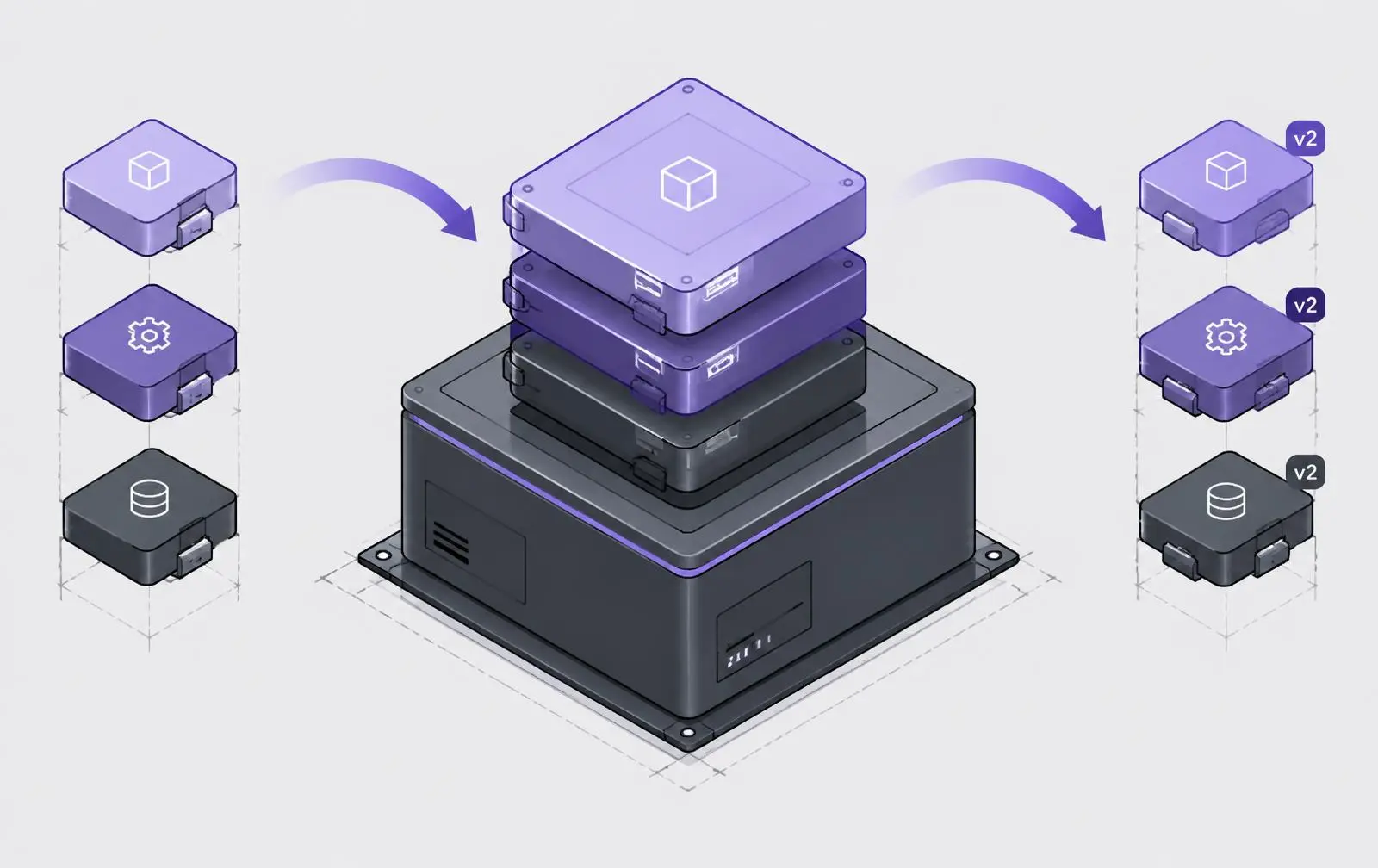
Upgrade-safe ERPNext customization means using configuration first, placing all custom code in separate Frappe apps that use documented hooks, keeping fixtures and patches versioned, testing against the target ERPNext version in CI, and moving high-volume or independent logic into external services with explicit API contracts. Never edit ERPNext or Frappe core files.
Key takeaways
- Core edits turn every upgrade into a merge project.
- Choose the lightest layer that solves the requirement.
- Treat a Frappe app like any product: versioned, tested, documented.
- Integration failures need queues, retries and ownership.
Why core edits create maintenance risk
A change to an ERPNext source file is overwritten or conflicts on the next update. Teams then either stop upgrading—accumulating security and functional debt—or spend each release re-applying patches nobody fully remembers.
Decision matrix: which layer?
| Requirement | Best layer | Why |
|---|---|---|
| Extra field, print format, simple approval | Configuration (Custom Field, Workflow, Print Format) | No code; survives upgrades |
| Small validation or automation | Server Script / Client Script (with discipline) | Quick, but harder to test—limit use |
| New business object or complex logic | Custom DocType in a Frappe app | Versioned, testable, upgrade-safe |
| Behaviour on standard documents | doc_events hooks in a Frappe app | Extends without editing core |
| High-volume, independent or non-Python processing | External service via REST API / webhooks | Isolates load and release cycles |
Engineering practices that keep upgrades possible
App structure and hooks
Use hooks.py for doc_events, scheduler_events, override_whitelisted_methods and fixtures. Prefer extending over overriding classes; when overriding is unavoidable, document why and test it.
Fixtures and patches
Export custom fields, property setters and roles as fixtures. Use patches for data migrations so every environment converges to the same state.
Permissions
Define roles and permission rules explicitly; never bypass permissions in whitelisted methods without a deliberate check.
Testing and CI
- Unit tests for business logic in the app.
- Integration tests against the target ERPNext/Frappe version.
- A staging site upgraded before production on every release.
- Automated checks that no core files are modified.
API contracts, background jobs and failure handling
- Version external API contracts and validate payloads.
- Run long tasks in background jobs (RQ) with retries and dead-letter handling.
- Make inbound webhooks idempotent.
- Store secrets in site config or a secret manager, never in code.
Illustrative architecture
| Component | Responsibility |
|---|---|
| ERPNext + custom Frappe app | Transactions, custom DocTypes, approvals |
| Integration service | Partner APIs, queues, retries |
| Mobile / portal app | Field capture via REST API |
| Reporting layer | Heavy analytics outside the transactional DB |
This architecture is an illustrative pattern, not published XWC intellectual property. A related real example is the ERPNext/Frappe-related workflow in our Track & Trace case study.
Operational handover
- Inventory of every customization and why it exists.
- Upgrade runbook and rollback plan.
- Named owners for the app and integrations.
- Monitoring dashboards and alert routing.
Related: ERPNext Implementation · System Integration · Software Engineering · Engineering Capacity.
Discuss a Frappe Extension or Engineering PodRequire a business case before approving an extension
Before discussing implementation mechanics, ask whether the requested difference deserves to become a permanent product obligation. A familiar screen or inherited spreadsheet rule is not automatically a business requirement. Describe the operational outcome, the people affected, and the consequence of leaving the standard process unchanged. This separates necessary differentiation from habits that could be addressed through process redesign.
A requirement admission checklist
- State the decision or transaction that cannot currently be completed, using business language rather than a proposed technical solution.
- Identify whether the constraint comes from an internal policy, a contractual obligation, or an externally imposed requirement; attach supporting evidence.
- Describe a workable manual alternative and its control weaknesses so reviewers can compare doing nothing with building something.
- Name the business owner who can retire the requirement when the underlying policy or process changes.
Use a short decision record containing the problem, alternatives considered, chosen outcome, rejected options, and review trigger. Keep technical preferences separate from acceptance criteria. For example, an approval requirement should describe who may authorize an exception and what evidence remains, rather than prescribe a particular button or script. This leaves engineers room to propose simpler solutions without weakening the business control.
Approve an exception only when the owner can explain why adapting the business process is insufficient. Where evidence is incomplete, commission a bounded investigation rather than treating an uncertain request as a committed feature. The output should be a decision, including a legitimate decision not to customize.
Define control boundaries before screen behavior
Customization can change who is allowed to act, what a record means, and which actions are reversible. These consequences deserve explicit business decisions before interface design. Map the lifecycle of the affected business object, including exceptions such as cancellation, amendment, reassignment, and retrospective correction. Do not assume that a successful happy path demonstrates an acceptable control design.
| Boundary question | Buyer decision | Evidence to request |
|---|---|---|
| Can someone approve their own exception? | Define separation of duties and permitted substitutes | Role-based scenarios showing allowed and denied actions |
| Can an approved value change later? | Define amendment authority and required explanation | Before-and-after examples with attributable changes |
| Can a record be removed? | Agree retention and correction expectations | Demonstration of correction without losing required evidence |
| Who owns a shared field? | Choose the authoritative business role | A field ownership map covering competing workflows |
Have the process owner review these boundaries with the relevant finance, security, or records specialist. Engineering should identify where a requested behavior conflicts with existing document semantics, but should not silently decide the business policy. Any legal retention obligation needs qualified interpretation; a custom field or activity log alone does not establish compliance.
Also examine alternate entry points. A restriction demonstrated on a form may not establish the same outcome for imports, background processing, or an integration. Ask for evidence appropriate to each supported entry point, and explicitly exclude unsupported paths. That makes the acceptance boundary visible to both users and future maintainers.
Assign decision rights with a lightweight RACI
A customization backlog needs business authority as well as engineering ownership. The following is a proposed responsibility model, not a description of an existing service agreement. R means responsible for producing the work; A means accountable for the decision; C means consulted; I means informed. Assign named people locally and avoid competing accountable owners for the same decision.
| Decision or deliverable | Business owner | Engineering lead | Control reviewer | Sponsor |
|---|---|---|---|---|
| Requirement justification | A/R | C | C | I |
| Technical feasibility record | C | A/R | C | I |
| Control exception approval | A | C | R | I |
| Business acceptance | A/R | C | C | I |
| Unresolved scope conflict | R | C | C | A |
Clarify the authority of a control reviewer before work starts. Some organizations require a separate policy owner to approve exceptions; adapt the matrix rather than letting a project role override that authority. A sponsor resolves competing priorities, but cannot make an untested behavior safe merely by accepting a delivery date.
Use decision deadlines tied to dependencies, not arbitrary urgency. If a policy choice blocks design, record what cannot proceed and what investigation can continue safely. Escalation should present alternatives and consequences. This prevents engineers from filling policy gaps with implementation assumptions that later become difficult to reverse.
Buy acceptance evidence, not just completed features
Define acceptance around observable business outcomes before development begins. A demonstration proves that a presenter can complete a selected sequence; acceptance should establish that intended users can complete representative work and handle exceptions. Keep examples understandable to business reviewers, with the starting state, permitted actor, action, expected result, and evidence to retain.
- Include a normal transaction and an exception that requires a different decision maker.
- Ask a user without the relevant authority to attempt the same action and confirm the expected refusal.
- Exercise cancellation or correction after downstream work has begun, where that sequence is in scope.
- Compare the resulting records with the business meaning agreed during design, not merely with the appearance of the screen.
Separate defects from newly discovered requirements. If the agreed rule is not met, record a defect against that rule. If stakeholders now want a different rule, capture a change for prioritization. Ambiguous examples should trigger clarification rather than a contest over whether work is finished. Preserve the approved examples so a future maintainer can understand why the behavior exists.
For uncertain behavior, use a disposable proof of concept with explicit questions and exit criteria. Its purpose is to reduce uncertainty, not quietly become production software. Decide what evidence would justify proceeding, simplifying the requirement, or stopping. Any production implementation still needs its own acceptance boundary and accountable business approval.
Review customization as a portfolio of obligations
Individual requests can look modest while their interactions create a fragile operating model. Review related changes together by business process, shared records, and competing rules. The portfolio view should reveal where separate teams have encoded different interpretations of the same policy. It also helps buyers distinguish valuable differentiation from accumulated exceptions that nobody actively sponsors.
| Risk signal | Decision trigger | Possible response |
|---|---|---|
| Different teams claim authority over one value | Conflicting definitions appear in acceptance examples | Resolve ownership before approving either change |
| An extension serves a temporary policy | The policy receives an end date or replacement | Set a retirement review and identify affected records |
| Only one person understands the rule | No independent reviewer can explain its outcome | Fund knowledge transfer before expanding scope |
| A standard capability appears to overlap | A later product release offers a candidate alternative | Compare business semantics before deciding to replace |
Treat these as review triggers rather than automatic reasons to remove functionality. Replacing an established extension can require user retraining, data interpretation, and changes to connected processes. A standard feature with a similar label may not preserve the same controls. Require an explicit comparison of outcomes and transition consequences before approving consolidation.
At each portfolio review, choose among retain, simplify, investigate replacement, or retire. Record the owner and the next evidence needed. An extension without an active sponsor should enter review, not disappear abruptly. Users may still depend on it even when its original justification has been lost.
Plan how the business can stop using an extension
Reversibility is a purchasing criterion. Before commissioning a change, ask what would happen if the organization changed policy, replaced the implementation team, or adopted a different operating process. Identify which records must remain understandable after the extension is disabled and which user decisions depend on its historical values. Retirement planning makes long-term ownership more concrete.
Ask prospective delivery teams to explain how they would challenge an unnecessary request, not just how they would build it. A useful response distinguishes business necessity from implementation convenience and makes unresolved choices visible. This helps procurement assess judgment without assuming that every proposed feature deserves approval.
A practical exit decision
- Define the condition that makes the extension unnecessary and who may confirm that condition.
- Identify active work that must finish before new use stops, including exceptions awaiting approval.
- Agree how users will interpret historical records without relying on an obsolete screen or calculation.
- Specify the business checks required before removing obsolete fields, roles, or supporting components.
Retirement can be staged: stop creating new work, complete or transfer outstanding items, preserve required evidence, then remove inactive behavior after review. Avoid deleting historical meaning merely to reduce visible clutter. The right outcome may be read-only access to legacy information while the new process becomes authoritative.
Xyncwave is an implementation and engineering firm; ERPNext is third-party software from Frappe. Buyers can use a scoping conversation to discuss requirement boundaries and decision evidence without assuming that a proposed extension is a standard ERPNext capability.
Frequently asked questions
Are Server Scripts upgrade-safe?+
They survive upgrades but are hard to test and review. Use them sparingly and move important logic into an app.
Can we fix an already core-modified system?+
Yes: inventory the diffs, move each change into an app or configuration, then upgrade on staging.
When should logic live outside ERPNext?+
When it is high-volume, has an independent release cycle or needs a different runtime.
How often should we upgrade?+
Follow supported major versions and apply minor releases regularly through staging.
Do you provide dedicated Frappe engineers?+
We can provide engineering capacity scoped to your roadmap; staffing details are agreed per engagement.
Start the conversation
Discuss a Frappe Extension or Engineering Pod
Describe the customization or system you need to stabilize. We will discuss the engineering approach.